
How might we help drivers stay calm during traffic jam?
A hands-free, audio-first mindfulness app designed with driving context in mind.
My first design to code project.
Overview
The Challenge: Daily commuters experience severe stress that impacts their entire workday, yet no mindfulness solutions work safely while driving.
The Solution: First-to-market mindfulness app designed for driving with hands-free audio guidance and zero visual distraction.
My Impact: Solo Product Designer & iOS Developer delivering end-to-end product—from user research through functional prototype—in 6 weeks.
Background
The Problem: Traffic stress creates anxiety, reduces workplace productivity, and affects relationships. Existing solutions aren't designed for driving safety constraints.
Critical Design Constraints:
Strategic Approach: Made safety constraints the product's competitive advantage rather than limitations to work around.
Empathize
3 User Personas Identified:
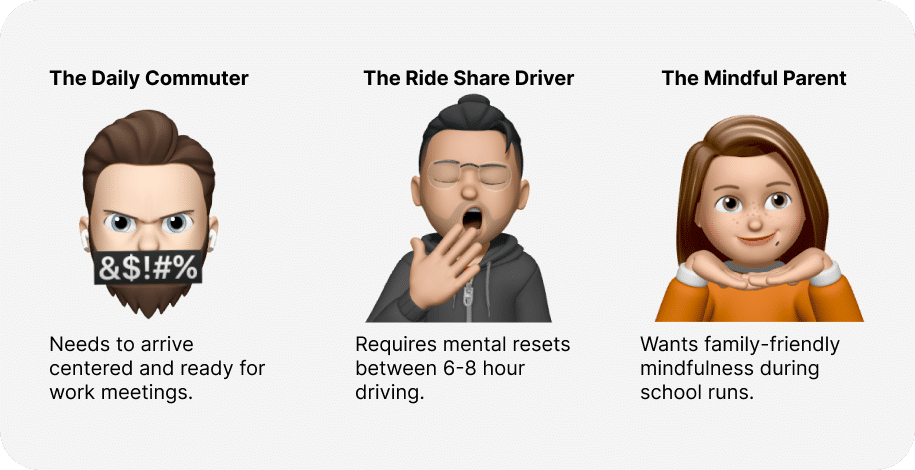
Research Value: Informed feature prioritization and content strategy for distinct user needs.
Desk research
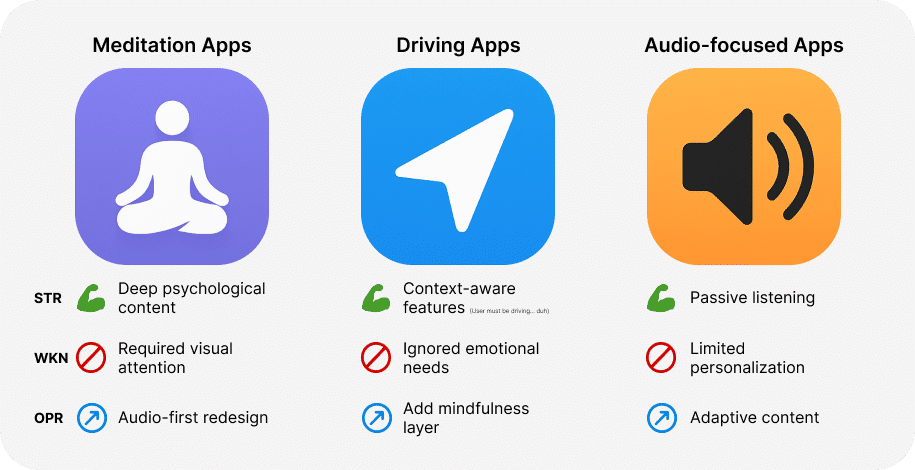
Competitive Analysis Results:
User interview
Research Method: In-depth interviews with daily commuters experiencing severe traffic stress
Critical Insights:
Product Impact: Shaped core value proposition—transform uncontrollable traffic time into acceptance practice opportunities.
Ideate
3 Solutions Evaluated:
- Mindfulness only when stopped → ❌ Traffic unpredictability makes this unreliable
- Pre/post-drive exercises → ❌ Misses peak stress during commute
- Guided mindfulness while driving → ✅ Selected: Addresses stress at source with audio-only, hands-free safety
Core Design Principles:
Prototype
3-Phase Design Process:
Phase 1: Sketches → Core navigation and breathing visualizations
Phase 2: Lo-Fi Wireframes → User flow validation and information architecture
Phase 3: Hi-Fi Prototype → Pixel-perfect, one-handed interaction optimization
Validation Result: Users preferred simplicity—removed secondary navigation to focus on core mindfulness delivery.
Final result
Technical Implementation:
Functional iOS prototype in Swift/SwiftUI demonstrating full-stack capability
Core Features Delivered:
✓ Background Audio Playback - Continuous soundscapes using AVAudioPlayer
✓ Voice-Over Support - Full accessibility for hands-free interaction
✓ Ambient Soundscapes - Nature sounds with zero user intervention
✓ Guided Breathing - Voice prompts, no visual dependency
✓ Mood Check-ins - Optional post-drive emotional tracking
✓ Minimal Settings - Essential controls only, streamlined onboarding
Technical Stack: Swift, SwiftUI, AVAudioPlayer, CoreMotion (planned), State Management
Reflections
What Worked:
What I'd Improve:
Key Learnings:
Contextual Wellness: Demonstrated mindfulness can integrate into existing routines (driving, exercise, work) rather than requiring dedicated separate time.
Research-Driven Design: Effective UX research must observe actual behavioral patterns in real-world contexts, not just stated preferences.
Cross-Functional Value: Combining design and development expertise delivered cohesive product vision and reduced typical designer-developer friction.